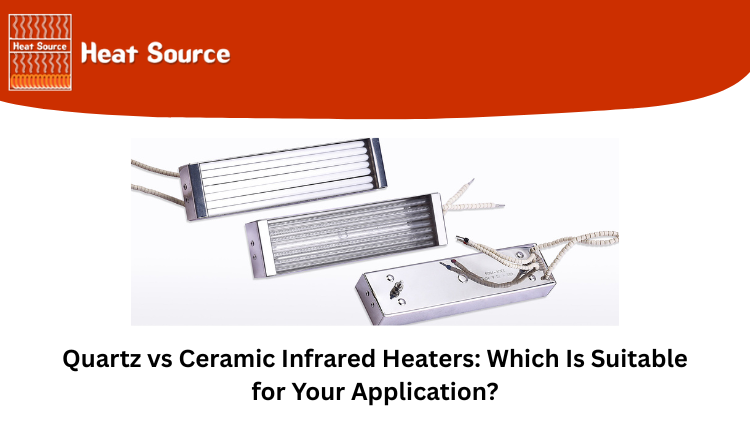
Quartz vs ceramic infrared heaters are used in industrial heating applications, but they differ in heating response, wavelength characteristics, and operating behaviour. Choosing the right option depends on the material being heated, the required temperature, production speed, and the configuration of the heating system.
For manufacturers working with plastics, packaging, thermoforming, coating, and drying processes, selecting a suitable infrared heater can affect heating consistency, cycle time, and overall process performance.
In this guide, we compare quartz and ceramic infrared heaters, explain their common applications, and outline the factors to consider when selecting an industrial infrared heating solution.
Infrared heaters transfer energy through infrared radiation, which is absorbed by the material being heated. Unlike systems that depend primarily on heating the surrounding air, infrared heating can deliver energy directly to a target surface, depending on the material's absorption characteristics and the system design.
Quartz infrared heaters and ceramic infrared heaters are used in industrial processes such as plastic processing, thermoforming, packaging, printing, coating, and drying. Their suitability depends on factors including wavelength, heater design, material properties, heating distance, and the required production cycle.
Understanding these differences helps manufacturers select an infrared heating solution that matches their application rather than choosing a heater based on type alone.
| Parameter | Quartz Infrared Heaters | Ceramic Infrared Heaters |
|---|---|---|
| Heating response | Often fast, particularly with suitable shortwave designs | Generally slower due to thermal mass and heat retention |
| Heat-up and cool-down | Typically faster, depending on design | Typically slower because the ceramic element retains heat |
| Wavelength | Can operate across different infrared wavelength ranges, depending on construction | Commonly associated with medium-wave to longer-wave infrared output |
| Heat penetration | Suitable for rapid surface and material heating | Suitable for more uniform, controlled heating |
| Best suited for | High-speed processes and quick heat cycles | Continuous heating and applications requiring stable heat |
| Temperature response | Rapid changes | More gradual and stable |
| Common applications | Plastic processing, thermoforming, drying, and coating | Thermoforming, plastics, paper, textiles, and drying |
| Heating characteristics | High-intensity radiant heating | Stable, uniform radiant heating |
Note: Exact performance depends on heater design, wattage, wavelength, material, distance, and process conditions.
Quartz infrared heaters are often selected for industrial processes that require a quick heating response. Depending on the heater design and wavelength, they can deliver radiant energy rapidly and respond relatively quickly to changes in power input.
They can be suitable for production lines where heating time, material movement, and production cycle duration are important selection factors.
Before selecting a quartz infrared heater, evaluate the material's absorption characteristics, required temperature, heater-to-material distance, and production speed. These factors help determine whether the heater's wavelength and output are appropriate for the process.
Ceramic infrared heaters provide stable radiant heating and are particularly useful when the process requires consistent heat over an extended period.
Their ceramic construction allows them to retain heat and provide steady infrared radiation, making them suitable for continuous industrial heating applications.
For processes where consistent heat distribution and controlled heating matter more than extremely fast response, ceramic heaters can be a better option.
Both quartz and ceramic infrared heaters can be used for thermoforming, but the right choice depends on the material and production requirements.
Quartz heaters can be preferred when the process requires rapid heating and a fast response to changes in heating output.
Ceramic heaters can be suitable when stable, uniform heating is required over a larger area or during continuous operation.
The material thickness, heating zone, conveyor speed, heater-to-material distance, and required temperature should all be considered before selecting the heater.
Selecting between quartz and ceramic infrared heaters requires an understanding of the material, process conditions, and heating objectives. Consider the following factors before choosing an industrial infrared heating solution.
Different materials absorb infrared radiation differently. The material type, thickness, surface properties, and wavelength compatibility all influence heating performance.
Consider how quickly the material needs to reach the target temperature and whether the production line requires frequent changes in heating output.
Evaluate the size of the heating area, the arrangement of the emitters, heater spacing, and the distribution of radiant energy across the target material.
Determine the required material temperature and operating conditions. The heater must be suitable for the actual process temperature and the manufacturer's specified operating limits.
The dimensions of the target surface and the distance between the heater and material influence the required heater arrangement and radiant output.
Consider whether the process involves intermittent heating, continuous operation, rapid start-up, or frequent temperature adjustments.
Review the available wattage, voltage, control system, heating zones, and temperature-monitoring requirements to ensure compatibility with the machinery.
Evaluating these factors together helps identify a heater configuration suited to the process, instead of selecting a heater based on its construction alone.
The choice ultimately depends on your process requirements rather than simply the heater type. Choose quartz infrared heaters when rapid response, quick heating, and high-speed heating cycles are priorities.
Choose ceramic infrared heaters when stable, consistent, and uniform radiant heating is more important for the process.
If you are unsure which option is suitable, factors such as material, heating distance, required temperature, wattage, heating area, and production speed should be evaluated together.
The right supplier, importer, or manufacturer plays an important role in selecting a suitable industrial heating solution. Heat Source offers industrial heating solutions for different process requirements, with expertise across infrared and other industrial heating technologies.
The team can help evaluate your application and recommend suitable heater configurations based on your machinery, heating requirements, and process conditions.
Where applicable, Heat Source can also guide you on small practical modifications to machinery that may improve heating performance and results.
Both quartz and ceramic infrared heaters offer efficient radiant heating, but they serve different process requirements. Quartz infrared heaters are well suited to applications requiring rapid heating and fast response, while ceramic infrared heaters are often preferred for stable and consistent heating.
The right choice depends on your material, heating area, temperature requirement, cycle time, and machinery configuration. Evaluating these factors can help you select an infrared heating solution that meets your production requirements.
Contact Heat Source for application-based guidance on selecting an appropriate industrial infrared heating solution. Discuss your material, heating specifications, production requirements, and equipment configuration with the team. Contact Heat Source to find a suitable heating solution for your application.
Quartz infrared heaters can offer a faster heating response, depending on their design, while ceramic infrared heaters generally retain heat longer and respond more gradually. The suitable option depends on the material and process requirements.
Ceramic infrared heaters are commonly used in continuous industrial heating applications because their ceramic elements retain heat. Their suitability depends on the required temperature, heating area, and process conditions.