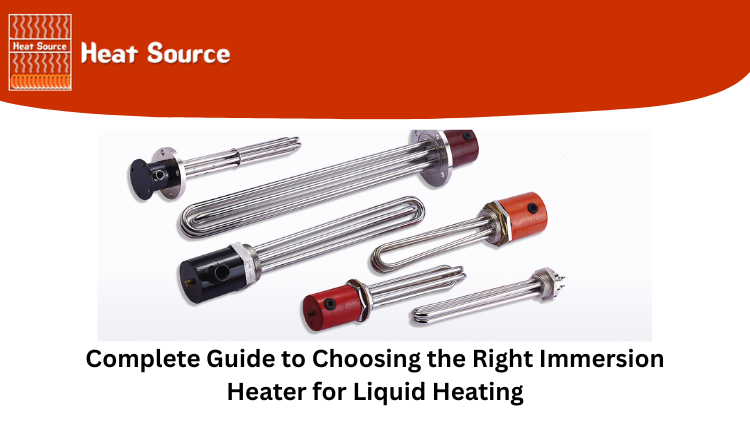
Efficient liquid heating is a critical requirement across industries such as pharmaceuticals, chemicals, food processing, oil and gas, and water treatment. Whether you're heating water, oils, chemicals, or process fluids, selecting the right immersion heater directly impacts energy efficiency, process performance, and operational costs.
With a wide range of industrial immersion heaters available, choosing the right solution can seem overwhelming, especially when factors such as liquid type, operating temperature, watt density, heater material, and heating capacity need to be considered. This guide covers everything you need to know to select the best immersion heater for your liquid heating application.
An immersion heater is an electric heating element that is directly immersed in a liquid to provide efficient and controlled heating. Since the heating element comes into direct contact with the liquid, immersion heaters can provide efficient heat transfer and help maintain consistent temperatures throughout the heating process.
Industrial immersion heaters are commonly used in tanks, vessels, pipelines, and processing equipment where reliable and controlled liquid heating is essential.
Every industrial process has unique heating requirements. Selecting an unsuitable immersion heater can affect heating performance, energy consumption, equipment life, and overall process efficiency. Common problems include:
A properly selected immersion heater can help achieve faster heating, improved process efficiency, and long-term operational reliability.
The properties of the liquid being heated play a significant role in heater selection. Water, oils, chemicals, acids, and corrosive liquids require different sheath materials and heating capacities to ensure safe and efficient operation.
Determine the required operating temperature for your application. High-temperature processes demand heaters specifically designed to withstand elevated temperatures while maintaining consistent performance.
Watt density refers to the amount of heat generated per unit surface area of the heating element. Selecting the correct watt density helps prevent overheating, protects the liquid, and extends the heater's service life.
The sheath material should be compatible with the liquid to prevent corrosion and ensure durability. Common materials include stainless steel, titanium, and copper, depending on the application.
The size of the tank and the volume of liquid determine the heater's wattage requirements. A properly sized immersion heater ensures faster heating without excessive energy consumption.
Pairing an immersion heater with thermostats, thermocouples, or temperature controllers improves accuracy and protects the system from overheating.
Selecting the correct heater capacity is essential for achieving the required heating time without unnecessarily increasing energy consumption. The required heating capacity depends on several factors, including the volume and type of liquid, initial and target temperatures, desired heating time, specific heat of the liquid, and heat losses from the tank or equipment.
For accurate heater sizing, these operating conditions should be evaluated before selecting the heater wattage. An experienced immersion heater manufacturer can help determine the appropriate heating capacity and heater configuration based on the specific application.
Immersion heaters are widely used across industries where controlled and efficient liquid heating is required. Common applications include:
Their versatility makes industrial immersion heaters suitable for a wide range of liquid heating applications, from heating water and process fluids to maintaining specific temperatures in chemical, pharmaceutical, food processing, and other industrial processes.
Because the heating element is directly immersed in the liquid, heat can be transferred efficiently to the surrounding fluid. This can help reduce heating time and improve overall process efficiency.
Immersion heaters transfer heat directly to the liquid, which can provide efficient heat transfer and help reduce unnecessary heat losses. Proper heater sizing and temperature control can further improve energy efficiency and operating costs.
Consistent heating helps maintain product quality and improves process reliability.
Built with durable materials, industrial immersion heaters require minimal maintenance and offer a long service life.
Industrial immersion heaters can be customized in terms of size, wattage, voltage, sheath material, mounting arrangement, and other specifications to suit specific liquid heating requirements.
When selecting an immersion heater, avoid these common mistakes:
Working with an experienced supplier helps ensure the heater is correctly specified for your application.
Heat Source manufactures industrial immersion heaters designed for efficient and reliable liquid heating applications across different industries. The heaters can be customized according to factors such as liquid type, operating temperature, required wattage, heater material, tank configuration, and other application-specific requirements.
Heat Source focuses on selecting suitable heating elements and materials based on the operating conditions of each application. This helps customers choose an immersion heating solution that provides reliable heat transfer, consistent performance, and long service life.
Each immersion heater is manufactured using application-appropriate materials and configurations to support efficient heat transfer, durability, and dependable performance in industrial environments.
Selecting the right immersion heater is essential for achieving efficient, safe, and cost-effective liquid heating. Factors such as liquid type, operating temperature, watt density, heater material, heating capacity, electrical requirements, and installation conditions all play an important role in determining the right immersion heater for an application.
By partnering with a trusted immersion heater manufacturer like Heat Source, businesses can invest in heating solutions that improve productivity, reduce maintenance, and deliver long-term operational reliability. Whether you need a standard or customized immersion heater, selecting the right heating solution can help improve process efficiency, reliability, and equipment performance. If you need help selecting an immersion heater based on your liquid, operating temperature, heating capacity, or other application requirements, contact Heat Source to discuss your specific requirements.
The right immersion heater depends on factors such as the type of liquid, operating temperature, required heating capacity, watt density, heater material, electrical supply, installation method, and available space.
The sheath material depends on the liquid and operating conditions. Common materials include stainless steel, titanium, and copper, with the appropriate material selected based on factors such as corrosion resistance, temperature, and liquid compatibility.